Winning Medical Coding Defense with AI
Medical Coding, Legal Defense, AI Strategy
Building Winning Medical Coding Defense Strategies in the Age of AI
Coding disputes are no longer rare exceptions—they are a predictable part of modern healthcare reimbursement. With constant CPT, ICD‑10‑CM, and CMS updates, even careful providers and law firms can find themselves defending perfectly appropriate claims. The firms that consistently win aren’t just good at arguing; they are meticulous about documentation, obsessed with guidelines, and increasingly powered by AI.
Building Winning Defense Strategies
A winning coding defense is built long before an appeal letter is drafted. It starts with a clear framework: identify the dispute type, map it to the exact evidence insurers expect, and connect that evidence to current guidelines. In 2026, that framework must account for hundreds of new ICD‑10‑CM diagnosis codes, fresh CPT and HCPCS updates, and revised National Coverage Determinations that directly affect what payers consider payable care.
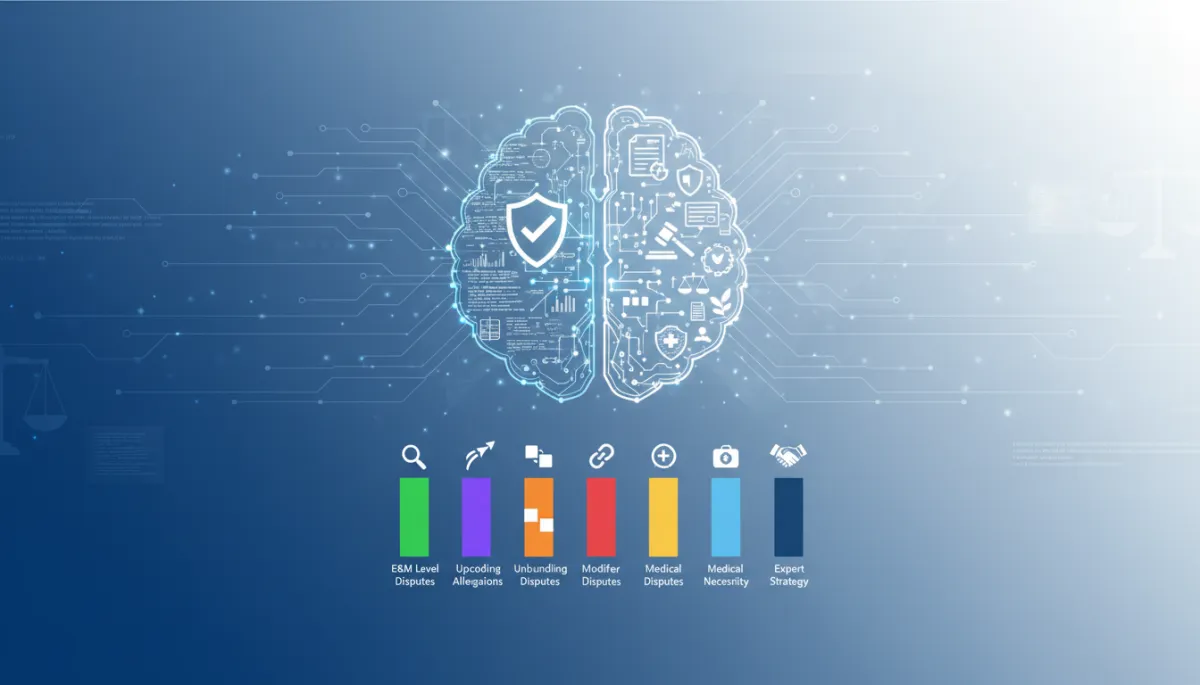
Defense-minded firms treat every claim as potential litigation material. They segment disputes—E&M levels, upcoding, unbundling, modifiers, medical necessity, time-based coding—and build repeatable playbooks for each. AI tools can now power these playbooks, rapidly matching claims to similar successful defenses across specialties and payers, so you are never starting from a blank page.
Document Everything: Your First Line of Defense
Every coding dispute is, at its core, an argument about documentation. Insurers exploit missing details: unrecorded complexity, absent time logs, vague operative notes, or incomplete histories. Each dispute type has its own documentation fingerprint—what must be present for the code to stand. For example, time-based E&M services live or die on precise start–stop times and what was actually done during that time, while upcoding allegations hinge on whether the record truly supports higher-intensity decision-making and risk.
AI changes the game by performing documentation gap analysis at scale. Instead of a human paging through dozens of notes, AI can scan the record, compare it to the standard documentation pattern for that dispute type, and flag what’s missing before it becomes a denial point. That might mean spotting absent staging for a chronic ulcer under new 2026 ICD‑10‑CM codes, or missing laterality for expanded R‑series pain codes. The result is a record that tells a complete, defensible clinical story.
💡 Pro Tip: Treat every chart as if it will be Exhibit A. Build checklists by dispute type—then have AI review records against those checklists before claims ever go out the door.
Know the Guidelines: CPT, ICD‑10‑CM, CMS & NCCI
What was defensible last year may be indefensible today. For FY 2026 alone, ICD‑10‑CM added 487 new diagnosis codes, revised 38, and deleted 28, including expanded codes for toxic injuries, chronic ulcers, and location-specific pain. On the procedural side, the AMA’s CPT 2026 update introduced nearly 300 new codes, many touching remote monitoring, health AI, and emerging technologies. CMS followed with updated CPT/HCPCS lists, NCD coding revisions, and refreshed NCCI edits that govern bundling and add‑on codes.
Insurers know these changes in detail—and they use them. Winning attorneys and coding experts must speak the same language. That means citing the exact 2026 ICD‑10‑CM guidelines, the current CPT descriptors, Medicare Code Editor updates, and the latest NCCI manual when challenging denials. AI helps by instantly cross‑referencing claims against these evolving rule sets, but the strategy still rests on human professionals who understand how those rules apply to the facts of the case.
Pattern Recognition: Anticipate the Next Dispute
Insurers rarely invent new arguments. They recycle the same dispute themes—“level too high,” “services bundled,” “modifier inappropriate,” “not medically necessary”—across providers, regions, and specialties. Recognizing these patterns early lets you move from reactive firefighting to proactive defense. If you know a payer routinely challenges certain E&M levels or time-based services, you can tighten documentation and coding before those claims hit their systems.
AI excels at this kind of pattern analysis. By reviewing thousands of past disputes, it can surface which codes, modifiers, or combinations attract denials from specific payers, and which defense arguments have historically worked. That intelligence helps you prioritize where to invest documentation training, when to add clarifying language to operative reports, and how to craft preemptive appeal templates tailored to each insurer’s habits.

Visualizing dispute patterns reveals where targeted documentation upgrades deliver the biggest wins.
Expert Testimony Strategy: Medical Judgment + Coding Accuracy
Traditional expert witnesses focus on clinical appropriateness: Was the service reasonable, necessary, and consistent with standards of care? In coding disputes, that is only half the battle. The other half is whether the documentation and code selection accurately represent that care under current rules. A powerful defense pairs medical experts with coding experts, supported by AI-generated analyses that validate guideline alignment.
AI can prepare structured exhibits for testimony: side‑by‑side comparisons of the disputed claim with CPT descriptors, ICD‑10‑CM definitions, NCCI edits, and local coverage determinations. It can highlight each documentation element that supports the code choice, making it easier for experts to explain complex coding logic in plain language to arbitrators, judges, or juries. The result is a two‑pronged defense: “The care was appropriate, and here is objective, guideline‑based proof that the coding was correct.”
The AI Advantage in Coding Defense
AI is not a replacement for legal or clinical judgment—but it is a force multiplier. In coding defense, its strengths align perfectly with the most time‑consuming tasks:
Instant guideline cross‑reference: Automatically check claims against CPT, ICD‑10‑CM, NCCI edits, and local coverage determinations, including the latest FY 2026 updates and quarterly HCPCS changes.
Pattern analysis: Surface similar successful defenses across specialties and payers, so your next appeal is informed by what has already worked in the real world.
Documentation gap analysis: Flag missing elements in medical records—such as staging, laterality, time logs, or comorbidity detail—before they become payer objections.
Precedent research: Identify prior cases, payer policies, or arbitration decisions where similar disputes were resolved favorably, and extract the reasoning that carried the day.
Industry data shows that 60–70% of appealed denials are overturned when providers actually pursue them, yet most denials are never worked. AI helps close that gap by making it faster to triage disputes, prioritize high‑value cases, and generate evidence‑rich appeal packages before critical deadlines pass and success rates drop.
Real‑World Success Rates by Dispute Type
When documentation and guidelines align, coding defense can be remarkably successful. Across defended disputes, firms using structured evidence and technology have achieved:
E&M level disputes: ~78% success when documentation clearly supports history, exam, and decision‑making complexity.
Upcoding allegations: ~85% success where detailed operative reports and risk factors substantiate higher‑level codes.
Unbundling disputes: ~72% success when clear procedural distinctions and NCCI guidance are documented.
Modifier disputes: ~81% success with precise use of modifiers and payer‑specific rules.
Medical necessity challenges: ~69% success when the record fully explains severity, failed conservative care, and clinical rationale.
Time‑based coding: ~91% success when accurate time logs and activities are documented and tied to guidelines.
These rates mirror broader billing research showing that 60–85% of well‑documented disputes can succeed. The common denominator is not luck; it is disciplined evidence collection and guideline‑driven argumentation, increasingly supported by AI analytics.
The Bottom Line: Turn Coding Challenges into Strategic Advantages
Successful medical coding defense is about understanding exactly what insurers are looking for in each dispute type—and delivering that evidence with precision. Thorough documentation that explains why a service was more complex, riskier, or more time‑consuming than usual is no longer optional; it is the price of admission to a successful appeal.
The attorneys and firms that win consistently are those who:
Understand CPT, ICD‑10‑CM, CMS, and NCCI guidelines as well as they understand legal principles.
Identify dispute patterns early and reinforce documentation before claims are submitted.
Gather specific, code‑level evidence tailored to each dispute category, rather than relying on generic medical arguments.
Leverage AI‑powered analysis to augment traditional legal and clinical expertise, not replace it.
AI‑driven platforms like CodexLegal.ai are designed for exactly this reality. By analyzing medical documentation against current coding guidelines in seconds, they identify the precise evidence needed to defend each of the seven major dispute categories. For law firms and providers, that means fewer surprises, stronger appeals, and the ability to turn coding disputes from costly distractions into a repeatable, strategic advantage.