Post-Payment Audits Surge: Insights for the Future
Revenue Integrity, Post-Payment Audits, Healthcare Compliance

Data-driven tools are enabling payers to scale post-payment reviews with unprecedented precision.
Post-Payment Audits Are Skyrocketing: What the Data Tells Us About The Future
Post-payment audits have shifted from background noise to a defining feature of the provider–payer landscape. Emerging data from 2025 and early 2026 show a sharp escalation in audit volume, financial exposure, and the sophistication of payer tactics across Medicare, Medicaid, and commercial plans, creating material legal, financial, and operational risk for providers.
A Cross-Payer Surge: Medicare, Commercial, and Medicaid Under the Microscope
The quantitative picture is unambiguous. The U.S. Government Accountability Office reported approximately $186 billion in improper payments in FY 2025 across 64 federal programs, an increase of about $24 billion over the prior year, with roughly 82% attributable to overpayments (Changeflow, 2026). Healthcare programs, including Medicare and Medicaid, are central contributors and a primary focus of recovery and enforcement activity.
Within Medicare Fee-for-Service, the 2025 Improper Payments Report identified $28.8 billion in improper payments, corresponding to an error rate of 6.55% (HBE Advisors, 2026). Even with a modest decline in percentage error, the absolute dollars at issue remain substantial, justifying—indeed incentivizing—aggressive post-payment review by CMS contractors and Medicare Advantage plans.
Commercial carriers and Medicaid programs are proceeding in parallel. Benchmark data for 2025–2026 indicate a 30% increase in total at-risk audit amounts and a 26% rise in outpatient coding denials (Neolytix, 2026). State programs are scaling accordingly: the Massachusetts Medicaid Audit Unit alone identified $8.45 million in potential cost savings between March 2025 and February 2026, with an expanding budget and approximately half of its audit costs reimbursed federally (Mass.gov, 2026).
What the 2025 Data Reveals: Audits, Recoupments, and Carrier Aggression
The volume of audits is only one dimension. The intensity and persistence of payer strategies have likewise escalated. In the first quarter of 2026, CMS identified approximately $850 million in overpayments through medical review and collected $216 million via post-payment audits (CMS, 2026). Risk Adjustment Data Validation (RADV) audits added more than $24 million in additional overpayments for prior years, notwithstanding ongoing litigation over methodology and timing.
Commercial payers are adopting similar postures. A January 2026 Penstock case study reported that a second-pass audit of Medicare Advantage claims uncovered an additional $4.8 million in savings beyond first-line vendor findings (Penstock, 2026). The legal and practical implication is clear: payers are prepared to layer multiple audit passes until marginal recoveries are exhausted, and providers should assume that “closed” periods may be reopened through new audit channels.
“For providers, these trends convert post-payment audits from episodic events into a continuous, high-stakes compliance exposure.”
Why Audits Are Skyrocketing: The Core Drivers Behind the Surge
1. AI, Automation, and Data-Driven Detection
Advances in artificial intelligence and machine learning have transformed audit operations from manual sampling to continuous, algorithmic surveillance. Payers can now run automated reviews across billions of claim lines, flagging outliers in coding, utilization, documentation, and risk scores in near real time. Federal initiatives—such as expansion of the “Do Not Pay” program and the 2026 Ending Improper Payments to Deceased People Act—explicitly promote enhanced data sharing and automated checks (U.S. Treasury/GAO, 2026).
Practically, this means patterns that might once have remained undetected for years can now trigger rapid, large-scale post-payment reviews with minimal notice. AI does not fatigue, and it continuously re-screens historical data for recoverable dollars, creating a persistent enforcement environment.
2. Pandemic-Era Billing Changes Under the Microscope
COVID-19 emergency flexibilities substantially altered billing rules for telehealth, remote monitoring, testing, and inpatient/outpatient status. Providers adapted in real time, often with incomplete or evolving guidance. As those flexibilities are narrowed or rescinded, payers are retrospectively reassessing pandemic-era claims for:
Correct place-of-service and modifier usage for telehealth encounters
Medical necessity and documentation sufficiency under post-emergency standards
Appropriateness of inpatient versus observation status during surge periods
These retroactive reinterpretations are a major driver of current audit volume and are particularly problematic where documentation was not contemporaneously updated to reflect changing rules—a recurring theme in payer determinations and appeal decisions.
3. Financial Pressures and the Search for Recoveries
With improper payments at $186 billion federally and hospitals losing an estimated $5 million annually on unresolved denials—up to 5% of net patient revenue (Healthcare IT Today, 2026)—both public and private payers face intense pressure to demonstrate fiscal stewardship. Post-payment audits are among the most direct and politically defensible mechanisms to recoup funds, making them a preferred tool in the current budgetary environment.
4. Regulatory Mandates and Program Integrity Expectations
Oversight bodies are likewise tightening expectations. The Payment Integrity Information Act (PIIA) requires agencies to assess and mitigate improper payment risk, yet 12 of 24 agencies failed to fully comply in FY 2024 (GAO, 2025). This noncompliance is driving corrective action plans, expanded risk assessments, and more aggressive audit programs aimed at demonstrable progress. State Medicaid agencies operate under similar program integrity mandates, often supported by federal matching funds for audit activity.
💡 Pro Tip: From a legal standpoint, these statutory and regulatory mandates give payers a strong procedural justification for sustained—and increasing—audit activity.
Who Is Being Hit the Hardest? Provider Types Under Heightened Scrutiny
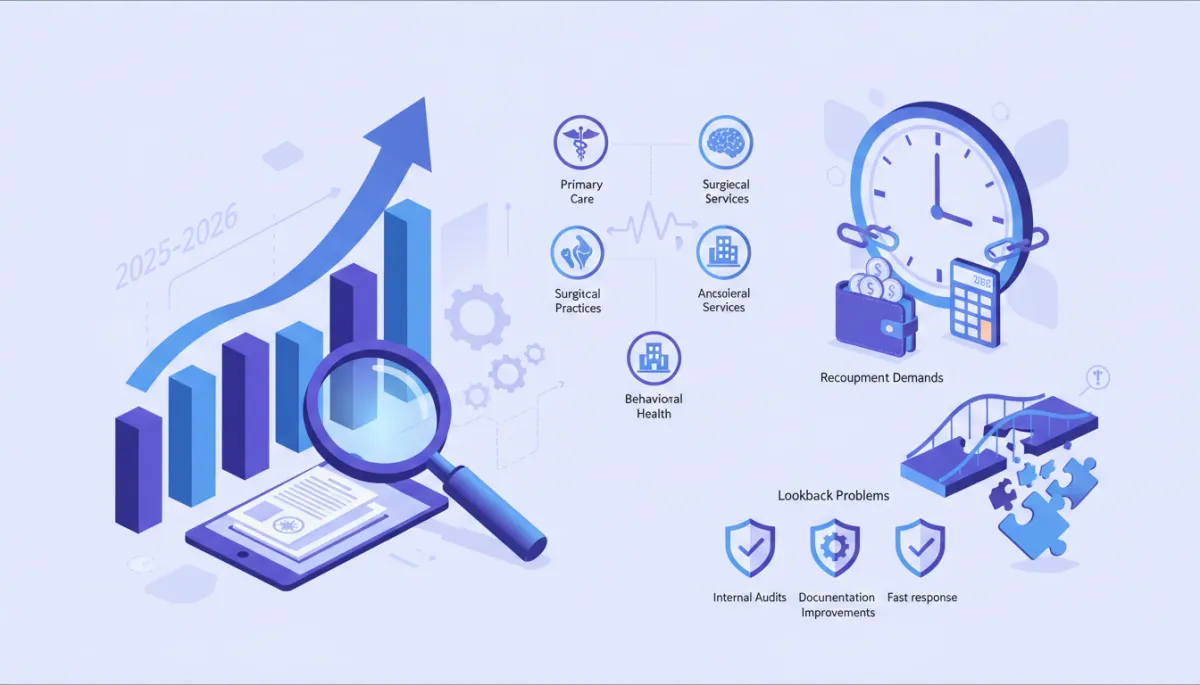
While no sector is insulated, recent patterns demonstrate concentrated activity in several provider categories. For healthcare entities and the agencies that support them, understanding these “hotspots” is critical for targeted compliance investment. Primary care practices—with high volumes of E/M visits, chronic care management, and preventive services—are frequent targets because AI tools readily flag outlier coding distributions (e.g., heavy use of higher-level E/M codes) and inconsistent telehealth documentation.
Specialty surgical practices (orthopedics, cardiology, gastroenterology) face intensive review of global periods, medical necessity, implants, and assistant-at-surgery billing, with rising outpatient coding denials disproportionately affecting these high-dollar claims. Ancillary providers—including labs, imaging centers, DME suppliers, and transportation providers—remain longstanding targets; the Massachusetts Medicaid Audit Unit’s focus on dental, transportation, and durable medical equipment underscores how ancillary services are viewed as fertile ground for recoveries.
Hospital outpatient departments are likewise in the spotlight as care shifts from inpatient to outpatient settings. Facility fees, infusion services, observation stays, and complex outpatient surgeries are subject to heightened scrutiny, with denial trends confirming that outpatient coding is now one of the highest-risk areas for post-payment review. Behavioral health providers—particularly tele-behavioral, intensive outpatient, and community-based programs—are experiencing increased commercial and Medicaid audits, where documentation of time, modality, and medical necessity is a recurring deficiency cited by payers.
The Lookback Problem and Extrapolation: How Small Errors Become Big Liabilities
One of the most disruptive legal features of modern post-payment audits is the multi-year lookback window. Depending on the payer and governing program rules, carriers may review claims that are several years old, often after personnel changes, evolving documentation standards, and potential challenges in retrieving complete records in a timely manner.
Compounding this is widespread use of statistical extrapolation. Rather than recouping only the amounts associated with a sampled set of allegedly non-compliant claims, payers frequently apply the observed error rate to a much larger universe of similar claims. For example, a 100-claim sample with a 10% “error” rate at an average value of $500 per claim can be extrapolated across 10,000 claims, transforming a $5,000 sample issue into a $500,000 recoupment demand.
For small and mid-sized practices, the intersection of extended lookback periods and extrapolation can create existential financial exposure. Even where providers ultimately prevail on appeal, the interim cash flow disruption, legal expense, and operational distraction can be substantial.
⚠️ Warning: Failure to challenge flawed sampling or extrapolation methodologies at the appropriate procedural stage can waive critical defenses later in litigation.
Settlement Pressure: How Carriers Leverage Demands, Offsets, and Timelines
In addition to technical findings, providers are increasingly encountering a sophisticated set of settlement pressure tactics designed to accelerate recoveries and discourage full-scale appeals. Carriers frequently open with large, extrapolated recoupment figures that anchor subsequent negotiations, even where they anticipate compromise. These “headline” numbers can materially influence internal decision-making at the executive level.
Demand letters often state that absent payment or agreement by a specified date, the payer will commence offsetting alleged overpayments against current claims. For providers operating on thin margins, the prospect of diminished current cash flow may be more alarming than the nominal recoupment amount. Compressed response windows for documentation, reconsideration, and appeal place revenue cycle and compliance teams in reactive mode; missed deadlines—even if inadvertent—can foreclose appeal rights or lock in unfavorable terms.
Looking Ahead: What to Expect in Late 2025 and Throughout 2026
Available indicators suggest that the current trajectory will not merely persist but accelerate into late 2025 and 2026. Providers should anticipate:
Expansion of audit scope to integrate medical necessity, risk adjustment, quality metrics, and social determinants of health data
Broader data-sharing among federal, state, and commercial payers, increasing the likelihood of copycat audits
More mature AI models with fewer false positives and more precise targeting of specific providers, service lines, and time periods
Regulatory flux will continue. Court decisions—such as those implicating the 2023 RADV final rule—will reshape methodologies and timelines for overpayment recoveries. However, uncertainty is unlikely to slow audits; rather, it will produce evolving payer playbooks that providers must monitor and address in real time.
How Providers and Agencies Can Prepare: From Passive Defense to Proactive Strategy
1. Build a Structured Internal Audit Program
Waiting for a payer letter to surface vulnerabilities is no longer tenable. Providers should implement risk-based internal audits that mirror payer tactics, using analytics to identify outlier coding, utilization, and denial patterns by provider, service line, and payer. Periodic sampling of high-risk claim types—telehealth, high-level E/M, infusion, behavioral health—is essential. Equally important is documenting findings, corrective actions, and education to demonstrate a robust compliance program if challenged.
2. Elevate Documentation Quality and Consistency
In most audits, the dispositive issue is not intent but documentation. Providers and agencies should prioritize clear linkage between diagnoses, services rendered, and medical necessity—particularly for high-intensity and behavioral health services. Consistent use of templates and checklists for telehealth, surgical consents, and time-based services can reduce variability. Ongoing provider education anchored in actual audit and denial examples, rather than abstract rules, materially strengthens defensibility.
3. Develop Fast, Coordinated Response Capabilities
Given compressed timelines, organizations need a centralized audit response function capable of logging, triaging, and tracking all audit requests and deadlines in a single system of record. That function should coordinate among HIM, billing, legal, compliance, and clinical leadership to assemble complete, consistent responses. Standardized response packages—including cover letters that clearly articulate the provider’s legal and clinical position and cite applicable policy—can materially improve outcomes.
4. Plan Financially: Reserves and Scenario Modeling
Post-payment audits now constitute a recurring operational risk. Finance leaders should establish audit and recoupment reserves calibrated to historical experience, payer mix, and specialty risk, and model cash flow impacts of potential offsets and extrapolated demands. Incorporating audit exposure into enterprise risk management and capital planning helps ensure that adverse determinations, while unwelcome, are not destabilizing.
5. Make Strategic “Fight or Settle” Decisions
Not every audit finding warrants full litigation, and not every demand should be accepted. Providers and agencies should develop decision frameworks that weigh:
Strength of documentation and legal arguments, including relevant precedent
Potential impact on future audits and payer relationships if a precedent is set
Total cost of defense (internal time, external counsel, expert review) relative to dollars at stake and extrapolation risk
The objective is to make “fight or settle” determinations that are deliberate, repeatable, and aligned with broader enterprise risk tolerance, rather than ad hoc reactions to individual letters.
A Profound Shift in Provider–Payer Relationships: The New Normal
The surge in post-payment audits reflects a structural change in how payers manage risk and how providers must manage revenue. What was once an episodic compliance concern has evolved into a permanent, data-driven feedback loop among claims, audits, and financial performance.
As a result, the provider–payer relationship is being recalibrated. Negotiations now extend beyond fee schedules to encompass audit protocols, data exchange expectations, and dispute resolution mechanisms. Trust is increasingly mediated by data quality, documentation rigor, and demonstrable internal controls, rather than solely by contractual language or historical relationships.
Over time, organizations that treat audit readiness as a core competency—integrating compliance, analytics, legal strategy, and financial planning—will be best positioned to thrive. Those that continue to view post-payment audits as occasional, unwelcome anomalies will remain on the defensive, absorbing avoidable write-offs and operational disruption.
As 2026 progresses, the message from the data is unequivocal: post-payment audits are not going away. They are becoming faster, smarter, and more interconnected across payer types. For healthcare businesses and agencies, the strategic question is no longer whether audits will occur, but how prepared you will be when they do, and how effectively you can convert a compliance imperative into a disciplined, sustainable element of your operating model.