Top 5 Audited Codes: AI Defense Strategies
Medical Audits, Coding Compliance, Legal Defense
The 5 Most Audited Code Categories (And Why You Need AI Defense)
Insurers are using sophisticated analytics and AI to challenge more claims than ever—especially in high‑volume, complex code categories. To keep pace, providers and their legal teams need an equally advanced defense strategy grounded in data, documentation, and carrier‑specific insight.
1. The 5 Most Audited Code Categories in Today’s Disputes
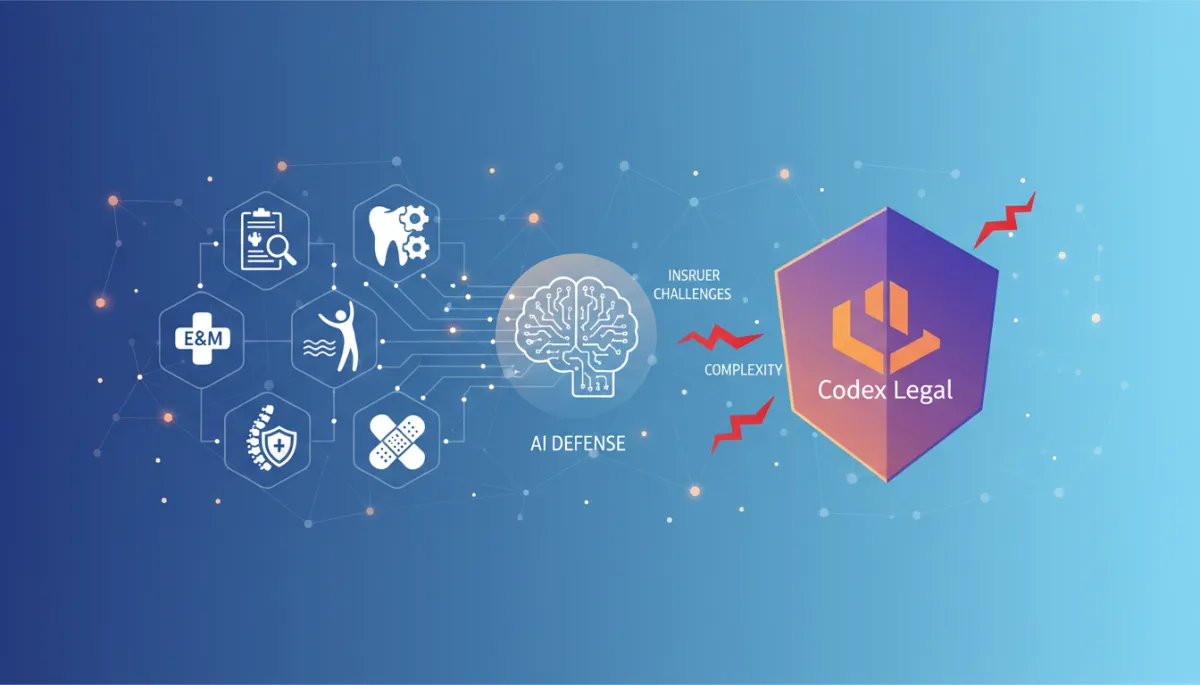
While payers are scrutinizing many parts of the code set, five categories consistently surface in audit disputes because they combine high volume, high dollar impact, and complex rules:
Evaluation & Management (E/M) Codes – Auditors focus on time‑based billing, Medical Decision Making (MDM), and whether documentation truly supports the level of service. Overreliance on phrases like “reviewed patient history” without detail is a known red flag (MedCloudMD, 2026).
Dental Codes – Insurers scrutinize frequency limits, bundling, and medical necessity for restorative work, periodontal services, and surgical procedures, often applying proprietary edits that differ by carrier.
Physical Therapy Codes – High‑volume therapeutic procedures and modalities invite audits around time units, one‑on‑one vs. group therapy, and overlap with other services rendered the same day.
Chiropractic Therapy Codes – Payers frequently question medical necessity, maintenance care vs. active treatment, and proper use of modifiers tied to spinal regions and visit frequency.
Wound Care Codes – High‑cost procedures, grafts, and skin substitutes are under intense review for adherence to LCD/NCD policies, product indications, and meticulous documentation of wound size, depth, and progression (Medryte, 2026).
2. How Insurers Target These High‑Volume, Complex Codes
Insurers are no longer relying solely on manual reviews. They are deploying AI‑driven algorithms to scan millions of claims and flag outliers across these categories. According to recent benchmark data, coding‑related denials in outpatient settings jumped another 26% after already steep increases, with payer AI systems now flagging claims retroactively—even after initial approval (Arintra, 2025).
In practice, this means:
E/M codes are profiled for unusual distributions of high‑level visits, heavy time‑based billing, or vague MDM documentation patterns across providers.
Dental, physical therapy, and chiropractic codes are compared to internal utilization benchmarks and policy rules to detect perceived “over‑treatment” or bundling opportunities.
Wound care codes are cross‑checked against coverage criteria, product approvals, and prior‑authorization data to justify downcoding or recoupment.
📌 Key Takeaway: When insurers use AI to find patterns, they are not just questioning single visits—they are challenging entire coding profiles over months or years.
3. Why Traditional Expert Witness Defense Is Falling Behind
Historically, providers facing audits or payment disputes would lean on a small group of clinical experts and coding specialists to review records, draft reports, and testify. That model is straining under today’s reality:
Volume overload: Payer AI can generate thousands of alleged overpayments at once. A human expert reviewing each encounter line‑by‑line is simply too slow and too expensive.
Complex, evolving rules: E/M, wound care, and therapy policies change frequently, and carrier‑specific interpretations often diverge from national guidelines. Keeping a single expert perfectly current across all payers is unrealistic.
Data asymmetry: Insurers are arguing from population‑level analytics and longitudinal trends. Traditional defense often relies on a handful of sample charts and subjective opinions, leaving providers on the back foot.

Combining expert judgment with AI analytics turns isolated charts into a defensible narrative.
4. Why You Need AI Defense—And What Codex Legal Delivers
If payers are using AI to attack, providers and their counsel need AI to defend. Codex Legal applies advanced AI analysis to the same high‑risk categories insurers target—E/M, dental, physical therapy, chiropractic therapy, and wound care—to create a data‑driven, scalable defense.
Drawing on the broader trend of AI‑integrated legal workflows—where AI is now considered essential infrastructure rather than an optional add‑on (ALA, 2026)—Codex Legal’s approach offers several practical advantages:
Speed at scale: AI can review thousands of encounters across multiple code categories in the time it would take a human expert to analyze a small sample, surfacing which claims are most defensible and which may warrant concession or settlement.
Cost‑effective insight: By automating the initial chart‑to‑code comparison, documentation audits, and pattern analysis, Codex Legal reduces reliance on hours of manual review—freeing experts to focus on strategy, testimony, and complex edge cases.
Objective, data‑driven arguments: AI can quantify how a provider’s coding compares to peers, highlight consistent documentation practices, and pinpoint where insurer edits deviate from published policy—turning raw data into clear, persuasive exhibits.
💡 Pro Tip: Use AI analysis early—before litigation escalates—to triage disputes, prioritize high‑value cases, and shape negotiation strategy around solid data.
5. Documentation, Insurer Challenges, and Carrier‑Specific Policies
Winning in these disputes is not just about “coding it right.” It is about showing that your documentation and coding align with the specific standards each carrier applies. That requires three layers of understanding:
Insurer challenges: What patterns is the payer alleging—upcoding, lack of medical necessity, unbundling? AI can map each alleged issue back to actual chart content and broader utilization trends.
Documentation requirements: For E/M, that may mean detailed MDM narratives; for wound care, precise measurements and staging; for therapy, clear treatment goals and progression notes. AI‑powered review helps identify where documentation already supports the code and where gaps exist.
Carrier‑specific policies: Each insurer may interpret national guidelines differently or impose additional restrictions. Codex Legal can align its analysis with the relevant LCDs, NCDs, and payer policies to show not just clinical validity, but contractual compliance.
Building a Smarter Defense Strategy Going Forward
As payers expand AI‑driven audits across E/M, dental, therapy, chiropractic, and wound care codes, providers who rely solely on traditional, manual expert reviews will face rising costs and shrinking win rates. By pairing clinical expertise with Codex Legal’s AI analysis, organizations can respond faster, argue from stronger data, and strategically protect revenue in the categories insurers target most.