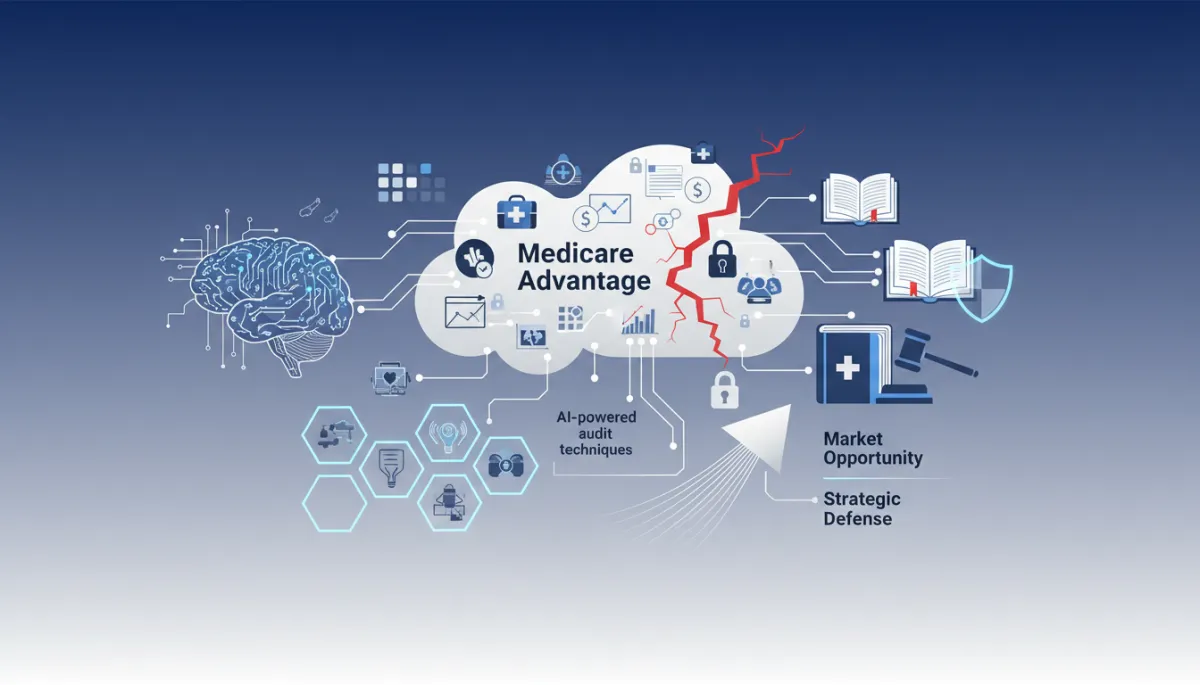
Medicare Advantage: Coding Defense in 2026
Medicare Advantage, Compliance, Coding, Defense Strategy
MA’s Coding Crackdown: What Defense Attorneys Need to Know in 2026
Medicare Advantage is entering a new era of aggressive audits, evolving risk models, and AI‑driven oversight. For defense attorneys, coding disputes are no longer a niche issue—they are a fast‑growing, high‑stakes practice area.
1. The Medicare Advantage Landscape in 2026
Medicare Advantage (MA) now covers roughly half of all Medicare beneficiaries, and CMS continues to refine how plans are paid. For calendar year 2026, risk scores will be calculated using 100% of the updated 2024 CMS‑HCC model, completing a multi‑year transition designed to better align payments with true clinical risk (cms.gov). Normalization of risk scores via multiple linear regression also continues, while the MA coding pattern adjustment remains at the statutory minimum, keeping payment impacts “neutral” on paper even as scrutiny intensifies in practice.
At the same time, CMS estimates an underlying 2.10% coding trend increase in 2026 and an overall 5.06% payment bump—more than $25 billion in additional MA payments system‑wide. Those dollars are driving a parallel push to claw back perceived overpayments through audits and enforcement.
2. Inside the Regulatory Crackdown and Audit Practices
CMS has rolled out an unprecedented expansion of Risk Adjustment Data Validation (RADV) audits. Instead of auditing roughly 60 plans per year, the agency now aims to audit all eligible MA contracts for each payment year and clear the backlog for 2018–2024 by early 2026 (cms.gov). Record samples have jumped from 35 charts per plan to as many as 200 records per plan, depending on enrollment.
Audit protocols are also evolving. New RADV frameworks emphasize simplified categories—such as Condition Accurate–Related (CAR), Observation, and Insufficient Documentation or Support (IDS)—and fold Compliance Program Effectiveness directly into audit reporting through quarterly compliance‑officer calls. Meanwhile, CMS is litigating to preserve or restore extrapolation authority, which could allow findings in a relatively small sample to be projected across entire contracts back to PY2018—a massive multiplier for alleged overpayments.
3. Common Coding Challenges Driving Disputes
Most MA coding disputes trace back to familiar pressure points, now viewed through a far harsher lens:
Documentation gaps: Diagnoses submitted for risk adjustment that are clinically present but not thoroughly documented (e.g., missing linkage, status, or treatment plans).
Diagnosis specificity: Insufficiently specific ICD coding, particularly where the 2024 CMS‑HCC model drops or reshapes certain conditions, leading CMS to question historical patterns.
Chart review and add‑on diagnoses: Scrutiny of diagnoses captured via chart reviews or vendor‑driven programs, especially as CMS moves toward eliminating “unlinked” chart reviews for risk adjustment in 2027—a sign of where enforcement is headed.
Prior authorization and medical necessity: MA plans must now rely on traditional Medicare coverage criteria for necessity and may not retroactively reverse approved inpatient admissions based on new information, raising complex coverage‑versus‑coding questions in appeals (cms.gov).

Coordinated legal–coding review often turns borderline RADV findings into defensible diagnoses.
4. The Legal Defense Landscape: Processes and Pressure Points
For defense attorneys, MA coding disputes play out across multiple forums: internal plan appeals, CMS administrative processes, contractual disputes between plans and providers, and, increasingly, False Claims Act (FCA) and whistleblower litigation. Legal processes typically involve:
Responding to RADV or targeted audit requests, including medical record production and narrative explanations of coding rationales.
Navigating CMS reconsideration and appeal pathways, where tight timelines and technical filing requirements create significant procedural risk.
Litigating contract disputes over who bears repayment liability—plan, delegated entity, or provider group—when audits result in recoupments or extrapolated overpayments.
Defending against FCA claims that allege “upcoding” or knowingly unsupported risk scores, often hinging on nuanced interpretations of CMS guidance and industry standards.
5. Emerging Trends: AI‑Powered Audits and Heightened Financial Stakes
CMS is not only expanding its human workforce—from roughly 40 medical coders to about 2,000 by late 2025—it is also deploying AI‑powered audit techniques to flag unsupported diagnoses more quickly and at scale. Pattern‑recognition tools can scan millions of records to identify anomalies in coding intensity, chart review behavior, or provider‑level outliers long before a traditional audit would surface them (cms.gov).
Against this backdrop, watchdogs estimate that MA plans will be overpaid by roughly $76 billion in 2026 alone, with potential overpayments reaching $1.2 trillion through 2035 (kiplinger.com). That fiscal narrative is fueling political support for aggressive enforcement and emboldening qui tam relators. Defense counsel should expect AI‑generated audit leads to convert into real investigations and, in some cases, civil or criminal exposure.
6. Best Practices for Defense Attorneys in MA Coding Cases
To keep pace with the crackdown, defense attorneys need a playbook that blends regulatory fluency, data literacy, and practical advocacy:
Master the 2024 CMS‑HCC model and ICD terminology shifts. Understand which conditions map to payment, how diagnosis groupings work, and where CMS has changed terminology from “disease codes” to “diagnosis codes” and groupings. Many disputes turn on these technical details.
Build cross‑functional defense teams. Pair legal counsel with certified coders, clinicians, and data analysts. Use internal “shadow” RADV reviews to stress‑test your client’s charts before CMS does.
Document compliance rigor. Robust compliance programs, regular internal audits, coder training, and prompt corrective action can be powerful evidence against allegations of knowing misconduct and may mitigate penalties (healthlawadvisor.com).
Use experts strategically. Engage respected clinicians and MA coding experts early to frame medical necessity, documentation sufficiency, and industry‑standard practices for regulators, judges, and juries (americanbar.org).
Leverage the appeals process and precedent. Carefully track deadlines, preserve all issues, and draw on favorable CMS decisions and case law to challenge extrapolation methods, sampling frames, and interpretations of coding guidance.
7. Strategic Defense Approaches in AI‑Driven Audits
As CMS and plans adopt AI to identify suspect coding, defense attorneys must be prepared to litigate not just the medical record, but the algorithms behind the case. Strategic responses include:
Demanding transparency into how AI models score risk, flag diagnoses, or rank providers, and challenging opaque systems that may embed bias or misinterpret clinical nuance.
Presenting alternative analytics that re‑create the population at issue using defense‑side tools, highlighting where CMS assumptions or sampling diverge from reality.
Framing AI outputs as investigative leads, not definitive proof, insisting that each alleged unsupported diagnosis be tested against clinical documentation and applicable coverage rules.
8. Market Opportunity: A Growing Niche for Defense Counsel
The same forces that worry plans and providers—escalating audits, complex regulations, massive potential extrapolated liabilities—create a significant market opportunity for defense attorneys who understand MA coding. Health systems, physician groups, MA plans, and delegated entities all need counsel who can translate technical risk adjustment rules into practical legal strategy, negotiate with CMS, and manage multi‑front litigation risk.
Firms that invest now in specialized MA audit teams—combining healthcare regulatory lawyers, litigators, coders, and data scientists—will be well positioned as CMS pushes to recover tens of billions in alleged overpayments over the coming decade.
9. The Bottom Line for Defense Attorneys
Medicare Advantage’s coding crackdown is not a passing phase—it is the new normal. With the 2024 CMS‑HCC model fully in force for 2026, RADV audits expanding to every eligible contract, AI‑powered detection tools, and mounting political pressure to recoup overpayments, coding disputes will only grow in volume and value. Defense attorneys who can navigate the MA landscape, understand the mechanics of risk adjustment and audit practices, and deploy sophisticated, data‑driven strategies will be indispensable to plans and providers alike.
In this environment, success means more than winning individual appeals. It means helping clients design documentation, coding, and compliance programs that can withstand the most aggressive scrutiny—human and algorithmic—and turning a regulatory threat into a durable, defensible business model.