
Extrapolation: Insurers' Claims Dispute Tactics
Insurance, Claims Disputes
Extrapolation: How Insurers Multiply Disputes 10x
When insurers use extrapolation to challenge claims, a single disagreement can suddenly become a fight over hundreds, or even thousands, of payments. Understanding how this works is the first step to protecting your rights and your business.
What Is Extrapolation in Insurance Disputes?
Extrapolation is a statistical shortcut. Instead of reviewing every single claim or payment one by one, an insurer looks at a smaller sample and then assumes that what they see in that sample applies across a much larger group of claims. They then “scale up” the results to recalculate what they believe they should have paid overall.
In theory, extrapolation is meant to save time and money in complex reviews. In practice, it often becomes a powerful tool for insurers to demand large repayments or deny future claims, based on limited data and broad assumptions. One alleged error in a handful of claims can be treated as if it exists everywhere, even when that is far from the truth.
For healthcare providers, contractors, and businesses that bill frequently, this can be especially dangerous. A small documentation issue in a sample of claims may be extrapolated to years of billing activity, transforming a modest disagreement into a staggering financial dispute.
How Insurers Turn One Disagreement Into a 10x Fight
The way extrapolation is used can effectively multiply disputes tenfold, or even more. The pattern often follows a familiar path:
The insurer selects a review period and pulls a sample of claims or invoices.
They identify alleged errors or “overpayments” in that sample, often based on documentation gaps, coding disagreements, or interpretation of policy language.
Instead of correcting just those claims, they apply the same error rate to the entire population of similar claims for that period.
The result is a demand to repay a vastly higher amount, or a blanket justification to deny or reduce future payments.
Imagine an insurer reviews 50 claims, decides 10 of them were overpaid by $200 each, and concludes there is a 20% “error rate.” If there are 1,000 similar claims in the full period, they may claim a $40,000 overpayment, even though they only reviewed $2,000 in actual disputed amounts. The math multiplies the disagreement 20 times, even if the underlying assumptions are shaky or the sample was poorly chosen.
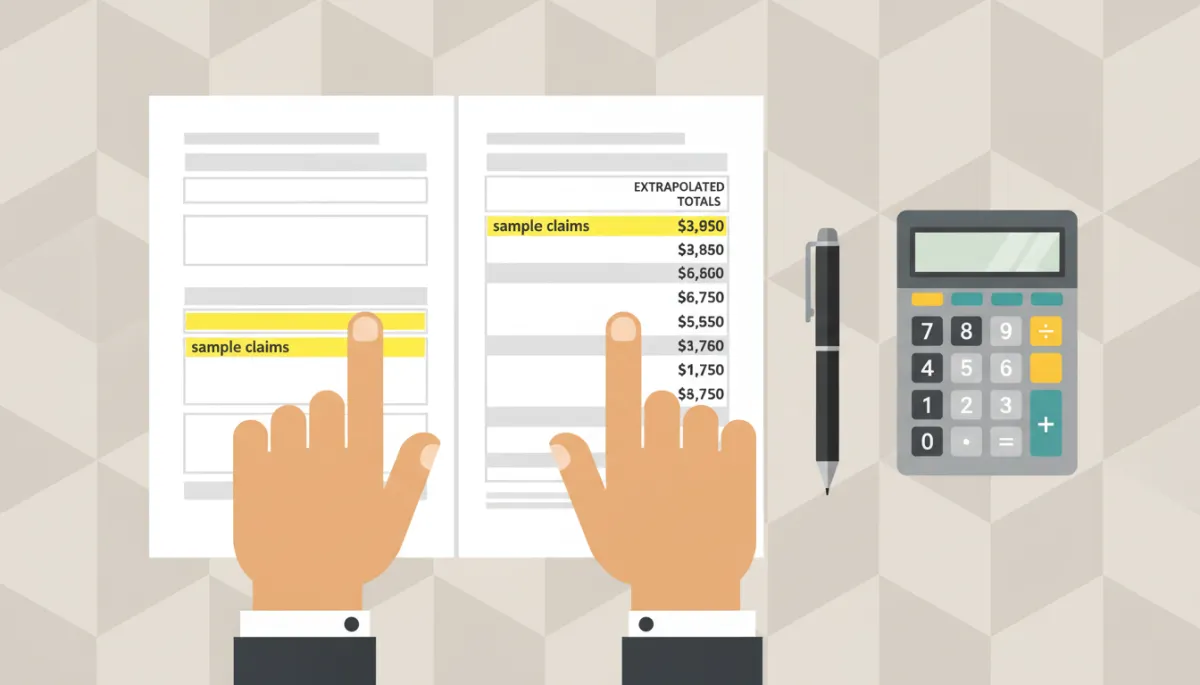
A small sample of questioned claims can snowball into a large repayment demand.
Why Extrapolation Is So Controversial
Extrapolation is controversial because it often blurs the line between efficiency and fairness. The insurer controls how the sample is drawn, how alleged errors are defined, and how the math is applied. If any of those steps are biased or flawed, the final numbers can be wildly misleading, yet still used as leverage in negotiations or appeals.
Policyholders and providers may feel trapped: fighting the methodology can be complex and costly, but accepting the extrapolated result can be financially devastating. This imbalance of power is precisely why extrapolation can multiply disputes 10x. The disagreement is no longer just about what happened in a few claims; it is about a sweeping conclusion that reaches across months or years of business activity.
Protecting Yourself When Extrapolation Is Used
If an insurer presents you with an extrapolated demand or denial, do not assume their numbers are final. Ask how the sample was chosen, what criteria were used to label claims as errors, and whether the population of claims they applied the rate to is truly comparable. Often, closer scrutiny reveals inconsistencies, flawed assumptions, or misapplied policy language.
Independent review, expert support, and clear documentation can help you push back against unfair extrapolation. By challenging the leap from a small sample to a massive repayment demand, you can reduce the dispute back to its proper size and focus the conversation on what actually happened in the claims themselves, not on a sweeping, one-size-fits-all calculation.