Chiropractic Disputes: Rising Insurance Denials
Chiropractic, Insurance Denials, Documentation, Healthcare Analytics, Codex
The Chiropractic Maintenance Trap: Why Disputes Are Rising
As a senior software engineer working with chiropractic practices, I keep seeing the same pattern: solid clinical care undermined by brittle documentation, opaque payer algorithms, and “maintenance care” labels that flip claims from payable to denied. This post unpacks why disputes are rising—and how Codex’s chiropractic defense capabilities, preventive documentation, and population-level analytics help you fight back with data instead of guesswork.
1. Why Insurance Denials Are Spiking for Chiropractors
From a systems perspective, payers are essentially running their own internal rule engines. Claims flow through layers of logic that evaluate:
Medical necessity flags (does the note justify active treatment?).
Benefit design (visit caps, exclusions, referrals, policy limitations).
Pattern recognition (treatment frequency, diagnosis mix, provider outliers).
Denials often trace back to the same root causes highlighted in recent insurance and documentation research ( Healthcare.gov, NCCIH, Chiropractic Economics):
Notes that look repetitive or “cloned,” suggesting predetermined care instead of patient-specific decisions.
Missing basics: duration of modalities, objective findings, functional limits, or clear treatment goals.
Care that continues past benefit caps or “usual” episode length without a documented change in status.
To a payer’s algorithm, these patterns scream “maintenance.” Once that label attaches, reimbursement collapses—even if, clinically, you are still delivering active, corrective care.
2. Active vs. Maintenance Care: The Distinction That Drives Coverage
Most plans do cover chiropractic, but the fine print usually draws a hard line between active care and maintenance care. As a developer, I think of it like two different states in a finite state machine:
Active care state: There is a diagnosed condition, functional impairment, and a reasonable expectation of improvement with treatment. Documentation must show: measurable baselines, a plan (frequency, duration, goals), and serial improvements or justified adjustments to the plan.
Maintenance care state: Care is primarily to maintain current status, prevent regression, or provide wellness support. Most commercial plans and Medicare classify this as not medically necessary and therefore not covered.
The trap is that payers don’t wait for you to say “this is maintenance.” They infer it from your data: long-running episodes with stable findings, vague goals (“feel better”), or language that sounds like wellness instead of correction all nudge the claim into the maintenance bucket.
💡 Developer’s lens: Think of each note as an event that either keeps the patient in an “active” state or transitions them to “maintenance” in the payer’s internal state machine. Your documentation language is effectively the state transition logic.
3. Documentation Challenges: When Clinical Reality and Payer Logic Diverge
Chiropractors are not losing denials because they don’t care about documentation—they are losing because the system design is misaligned with how they work. Studies in 2026 show that most chiropractic EHRs were built for primary care, not high-volume, hands-on practices ( Scribing.io, DataDrivenDoc).
Repetitive SOAP notes: 25–30 visits a day, with only minor variations. Fatigue leads to copy-paste, which looks like cookie-cutter care to auditors.
Fragmented systems: Scheduling here, notes there, billing somewhere else. Manual re-entry means missed fields and inconsistent narratives across systems.
Generic templates: EHR templates that don’t capture chiropractic nuance (segments, techniques, functional tests) force clinicians to “work around” the software instead of documenting naturally.
The net effect is documentation that feels clinically reasonable but fails payer rules: missing time units, absent objective findings, no clear discharge criteria, and no explicit tie between today’s care and functional improvement. That’s fertile ground for maintenance allegations.
4. Treatment Frequency Algorithms: When “Too Often” Triggers Audits
By 2026, payers are not just eyeballing your claims; they’re running them through treatment frequency algorithms. These are essentially machine-learning or rule-based systems that compare your patterns against internal benchmarks and published guidelines ( ChiroEco, Dynamic Chiropractic).
Too many visits per episode, per diagnosis, or per month can automatically flag your practice as an outlier.
High-frequency care without evidence of functional improvement often gets reclassified as maintenance in bulk, especially when objective scoring data is missing or incomplete.
Conceptually, payers are assigning a risk score to each episode based on visit volume, duration in weeks, documented functional change, and chronicity. Episodes with high utilization and low measured improvement are more likely to be tagged as maintenance, regardless of the clinician’s intent.
Real-world models are more complex, but the idea is the same: your frequency, duration, and outcomes are being evaluated as part of an internal scoring function. If you’re not measuring and documenting functional change, you’re effectively feeding the algorithm neutral or negative signals—and those signals push you toward a “maintenance suspected” classification.
5. Diagnosis Code Scrutiny: ICD Patterns as a Signal
Payers also scrutinize your diagnosis code mix. Clusters of chronic, non-specific, or stability-oriented ICD codes without clear acute findings can be interpreted as ongoing maintenance. Examples include:
Overuse of vague pain codes without underlying structural or functional diagnoses.
Chronic condition codes used for months or years with no documented transitions or flare-ups.
As engineers, we can treat this as a data-quality problem. If your ICD usage doesn’t reflect the clinical story—acute onset, progression, improvement, stabilization—then algorithms will assume the least payable interpretation: maintenance.
💡 Practical insight: Clean, specific diagnosis coding—aligned with documented findings and timeframes—is one of the cheapest defenses you have against maintenance allegations.
6. The Impact of Maintenance Care Allegations on Practices
When a payer decides your care is “maintenance,” the consequences cascade across your practice:
Immediate revenue loss: Visits are denied outright or recouped after post-payment review, compressing margins and cash flow.
Patient confusion: Patients are told “your chiropractor is doing non-covered maintenance,” which erodes trust even when your care is clinically justified.
Audit exposure: High maintenance flags can trigger deeper audits, demanding years of records and tying up staff in manual chart pulls and letter writing.
This is why disputes are rising: payers are scaling algorithmic scrutiny faster than individual practices can manually adapt. You can’t out-type an algorithm; you need your own data and automation on your side.
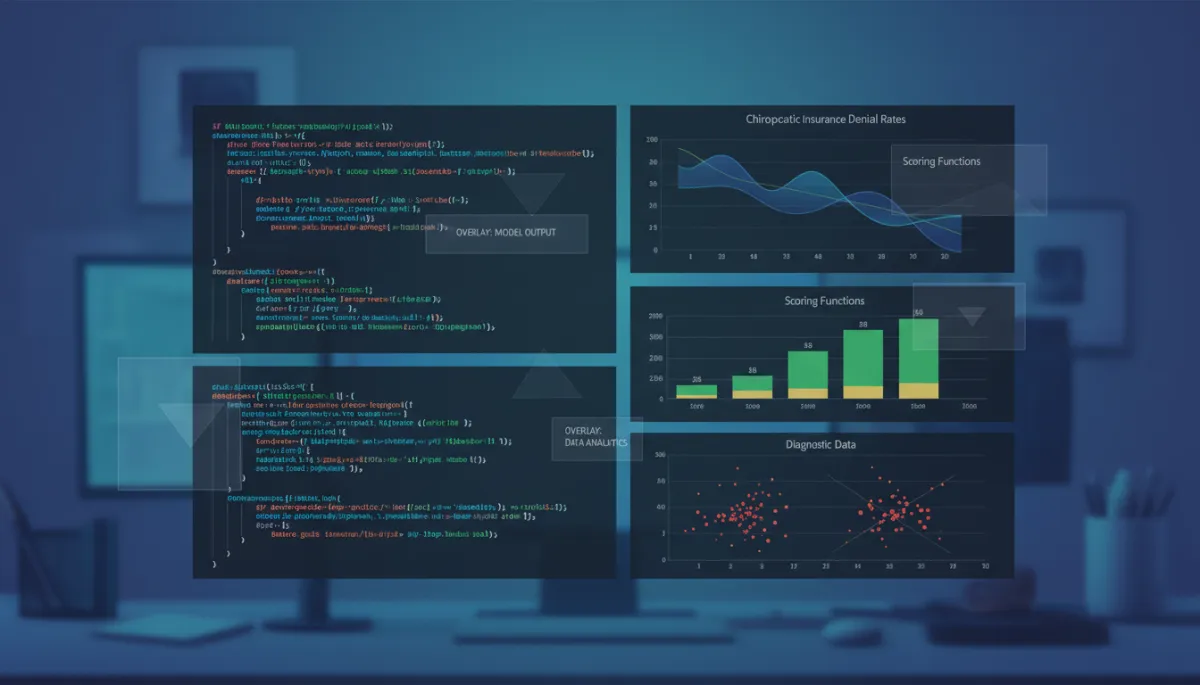
Visualizing denial patterns by diagnosis and frequency turns vague disputes into measurable problems.
7. How Documentation Language Drives Coverage Decisions
One of the most underrated factors is the language you use in notes. To an adjuster—or to an NLP model scanning your documentation—certain phrases scream “maintenance,” while others clearly support active care.
Maintenance-sounding phrases: “patient feels about the same,” “routine adjustment,” “wellness visit,” “patient likes to get adjusted weekly.”
Active-care-supporting phrases: “objective improvement in lumbar flexion from 45° to 70°,” “Oswestry score improved from 40% to 18%,” “treatment frequency reduced from 3x/week to 1x/week as goals met.”
As engineers, we can actually model this conceptually. Instead of thinking in terms of individual phrases, think in terms of a language risk profile: documentation that leans heavily on subjective wellness language, with no reference to functional goals, quantitative scores, or progression over time, will naturally sit higher on a maintenance risk scale.
Payers are using NLP pipelines to perform this kind of analysis at scale. If your documentation never mentions functional goals, objective scores, or quantifiable changes, it’s much easier for them to justify a maintenance label—even if that’s not how you see the care.
8. Codex’s Chiropractic Defense Capabilities: Building a Technical Shield
This is where Codex comes in. Think of Codex as a verticalized defense and analytics layer that sits on top of your existing EHR and billing stack. From a software architecture perspective, it ingests your notes, claims, and outcomes, then applies domain-specific logic to:
Detect patterns that payers might interpret as maintenance care before they become denials.
Generate defense packets for appeals that tie documentation, diagnosis codes, and outcomes into a coherent medical-necessity narrative.
Surface provider- and population-level analytics so you can adjust care plans and documentation before payers force your hand.
Under the hood, Codex is doing what we just sketched—but at scale and with chiropractic-specific intelligence: text analysis of documentation language, frequency modeling, ICD/CPT pairing validation, and benchmarking against known payer policies.
9. Preventive Documentation: Shifting from Defense to Design
The best denial is the one that never happens. Codex focuses heavily on preventive documentation—guiding providers in real time so that each note naturally supports active care when appropriate.
Prompts to capture functional baselines (ROM, disability indices, pain scales) at the start of care and at defined checkpoints.
Warnings when language trends toward maintenance-sounding phrases without corresponding active-care evidence.
Suggestions to explicitly document treatment plan transitions: reducing frequency, shifting from corrective to supportive, or discharging to wellness (with proper ABN or self-pay documentation where necessary).
Technically, this looks like a feedback loop: Codex parses the note, scores it for risk (frequency, language, diagnosis mix), then returns contextual hints. Conceptually, you can think of this as a service that continuously evaluates documentation quality and maintenance risk and then streams structured feedback back into the EHR interface.
Instead of scrambling when denials arrive, your clinicians get quiet, continuous guardrails that keep documentation aligned with payer expectations while still reflecting authentic clinical judgment.
10. Population Analysis: Seeing What Payers See—Before They Act
Individual notes matter, but payers are increasingly judging you at the population level. They look at your entire panel and compare it to peers: average visits per episode, chronic vs. acute mix, denial rates by code, and more ( Pryme Practice / BlueIQ analytics).
If your average episode length is 2–3x the regional norm, you will be flagged—regardless of how good your intentions are.
If a high percentage of your claims with certain ICD codes are denied as maintenance, that’s a signal you need to adjust either documentation or coding—or both.
Codex’s population analysis modules let you see these patterns from your side of the table. For example, you can query:
Denial rates by payer, diagnosis, provider, and episode length.
Distribution of visit counts per episode vs. peer benchmarks.
Correlations between documentation completeness (e.g., presence of functional scores) and approval rates.
At an architectural level, you can think of this as a continuous analytics pipeline: claims and clinical data are aggregated, transformed into episode-level features, and then benchmarked against internal and external norms so that high-risk patterns surface proactively.
Armed with this, you can redesign care pathways, update documentation templates, or even renegotiate with payers using your own data, not anecdotes. That’s a fundamentally different posture than waiting for audit letters to define your reality.
11. Putting It All Together: A Developer’s Playbook for Escaping the Trap
If I were designing a chiropractic practice from scratch in 2026 with an engineer’s mindset, here’s how I’d harden it against the maintenance trap:
Model the payer’s logic. Treat active vs. maintenance as explicit states and design documentation workflows that always record the data needed to justify the current state.
Instrument your documentation. Use tools like Codex to score notes for maintenance risk in real time and nudge providers toward more defensible language and structure.
Analyze your population. Regularly review episode lengths, frequency patterns, and denial clusters. Treat outliers as bugs in the system that need debugging, not as personal failures.
Close the loop. When denials do happen, feed them back into Codex as labeled data: what language, frequencies, or codes correlated with the denial? Then update templates and training accordingly.
Chiropractors didn’t create the maintenance trap—insurers did, by encoding their own definitions of medical necessity into increasingly aggressive algorithms. But with the right tooling, you can meet algorithms with algorithms, and documentation with defensible data.
12. Conclusion: From Reactive Disputes to Proactive Defense
Disputes over chiropractic “maintenance care” are rising because insurers have quietly shifted from manual review to automated suspicion. Denials now emerge from a web of treatment frequency algorithms, diagnosis code scrutiny, and NLP-driven documentation analysis that often underestimates the true clinical value of what you do.
Codex doesn’t change your clinical philosophy; it changes your data posture. By strengthening preventive documentation, analyzing your patient population at scale, and translating payer logic into actionable feedback, it helps your practice stay firmly in the “active care” column whenever that’s clinically appropriate—and equips you with robust chiropractic defense capabilities when disputes do arise.
In other words: you keep adjusting patients; Codex helps you adjust the story your data tells about that care. And in 2026’s insurance landscape, that story is often the difference between being paid for your work—or being trapped in the maintenance label with nothing to show for it.