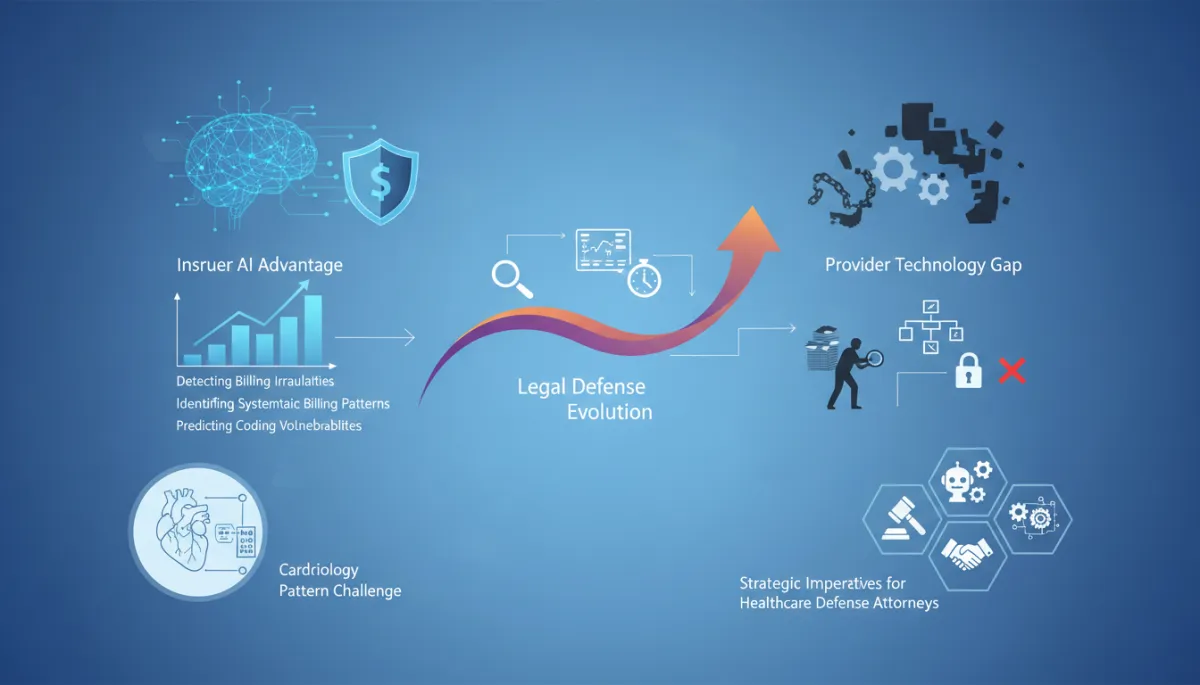
AI in Healthcare: Evolving Legal Defense Strategies
Healthcare Law, Artificial Intelligence, Litigation Strategy
The AI Arms Race in Healthcare: Why Legal Defense Must Evolve
Speaking as a senior software engineer who has built analytics for both payers and providers, the AI gap between insurers and healthcare organizations is no longer theoretical. It is already reshaping how billing disputes arise, how allegations are framed, and how fast cases move. Defense teams that treat AI as “someone else’s IT problem” are walking into an asymmetric fight they are not equipped to win.
The Insurer AI Advantage: From Irregularities to Pattern Allegations
Insurers have quietly spent years industrializing their data pipelines. Claims data is clean, centralized, and optimized for model training. That gives them a decisive AI advantage in detecting billing irregularities at scale. Models can flag outlier utilization, improbable combinations of CPT and ICD codes, or sudden volume spikes in specific procedures with near real-time latency .
import pandas as pd
from sklearn.ensemble import IsolationForest

claims = pd.read_parquet("claims_rolling_24m.parquet")

features = claims[[
    "allowed_amount",
    "units",
    "days_between_visits",
    "provider_specialty_code"
]]

model = IsolationForest(
    n_estimators=300,
    contamination=0.01,
    random_state=42
)

model.fit(features)
claims["anomaly_score"] = model.decision_function(features)
claims["is_suspect"] = model.predict(features) == -1
This kind of pipeline lets payers not only catch individual outliers, but also start identifying systematic billing patterns—for example, a cluster of providers in cardiology billing the same high-revenue code combinations with identical modifiers and timing. Once patterns are surfaced, they can be translated into pattern allegations: “For the period X to Y, Provider Group Z engaged in a systematic upcoding scheme for procedure family A.”
With enough historical data, the same models can be refit as predictive engines for coding vulnerabilities. Insurers can simulate policy changes, reimbursement shifts, or new CPT code introductions and forecast where abuse is likely to emerge. From an engineering perspective, that is just supervised learning on labeled “problematic” claims; from a legal perspective, it means payers arrive with pre-baked narratives about intent, design, and systematic behavior long before a subpoena is served .
💡 Pro Tip for Defense Teams: Assume every billing pattern in dispute has already been scored, clustered, and benchmarked against national peers by an insurer’s AI stack. Your job is to interrogate that stack, not just the final spreadsheet.
The Provider Technology Gap: Manual Processes in an Automated War
On the provider side, the story is very different. While clinical AI gets headlines, revenue-cycle AI often lags. Many organizations still have a significant provider technology gap in their billing and compliance stack: fragmented EHR exports, limited data science staff, and a patchwork of vendor tools that do not interoperate cleanly. The result is decreased automation adoption in exactly the domains where insurers are most advanced—claims analytics, anomaly detection, and pattern mining.
That gap creates obvious manual process vulnerabilities. When an audit letter arrives, internal teams scramble to pull CSVs, reconcile them with PDFs, and manually reconstruct billing logic. Excel becomes the primary “analytics engine.” Every manual step increases latency, error risk, and the chance that the defense narrative will be reactive instead of strategic. From a software perspective, this is like debugging a distributed system without logs, metrics, or version control.
Unsurprisingly, many organizations default to reactive defense strategies: respond to document requests, explain individual claims, and hope that demonstrating good faith will blunt the impact of pattern-level allegations. But when the other side is armed with model-driven heatmaps, cluster diagrams, and time-series analyses, “one-claim-at-a-time” is no longer a viable strategy. It is like answering a distributed denial-of-service attack by manually blocking IPs in a firewall UI.

Insurers arrive with pattern dashboards while providers are still scrolling spreadsheets.
Legal Defense Evolution: From Individual Claims to Systematic Defense
This imbalance is forcing a legal defense evolution from individual to systematic defense. Historically, healthcare defense focused on the medical necessity and documentation of specific claims. In the AI era, the unit of dispute is the pattern: a distribution of codes, modifiers, and timing across thousands of encounters. Defense teams must be able to reason statistically, not just narratively.
That shift amplifies the classic speed vs. accuracy tension. Insurers can spin up new models or rerun analyses on fresh data overnight. Defense teams, by contrast, often spend weeks just normalizing exports. Yet courts and regulators increasingly expect prompt, data-backed responses. The only sustainable answer is to build defense workflows where data ingestion, feature engineering, and basic pattern analysis are automated enough that attorneys can iterate quickly without sacrificing statistical rigor.
That is where pattern defense expertise comes in. Someone on the defense team—whether in-house or external—must be able to:
Reproduce, stress-test, and critique the insurer’s models and metrics.
Build counter-analyses that show alternative explanations for the same patterns (e.g., case mix, referral patterns, new guidelines).
Translate technical findings into narratives judges, arbitrators, and juries can understand.
At the same time, attorneys must develop technology neutrality arguments: frameworks that emphasize that AI is a tool, not an oracle. That includes probing data quality, feature selection, model bias, and validation methods, and arguing that legal conclusions cannot rest solely on proprietary algorithms whose inner workings are opaque. Regulatory commentary on AI in healthcare already stresses transparency, accountability, and bias mitigation (Healthcare Law Today, 2023), all of which can be leveraged in defense.
Case Study: The Cardiology Pattern Challenge
The Allegation
Consider a hypothetical 2026 dispute: a regional cardiology group faces a recoupment demand based on an insurer’s AI analysis. The model claims to have identified a systematic pattern of upcoding for certain echocardiography procedures, with unusually high use of add-on codes and modifiers compared to peer cardiology practices nationwide.
Traditional Defense Strategy
A traditional defense might focus on:
Manually sampling charts to show medical necessity for selected claims.
Expert testimony on cardiology guidelines and clinical judgment.
Attacking the insurer’s extrapolation methodology without directly engaging the underlying AI.
The weakness: it treats the AI-generated pattern as a black box and only argues around its edges. The insurer still controls the statistical narrative: “Your group is a three-sigma outlier; therefore, something must be wrong.”
AI-Enhanced Defense Strategy
An AI-enhanced defense strategy would start by rebuilding the analytics stack on the provider side. For example, counsel might work with a data team to cluster encounters and compare them to richer peer benchmarks:
from sklearn.preprocessing import StandardScaler
from sklearn.cluster import KMeans

cardio = claims[
    (claims["specialty"] == "Cardiology") &
    (claims["provider_group_id"] == "GROUP_123")
]

feature_cols = [
    "patient_risk_score",
    "age",
    "num_prior_cardiac_events",
    "visit_type_code",
    "procedure_family_code"
]

X = cardio[feature_cols]

scaler = StandardScaler()
X_scaled = scaler.fit_transform(X)

kmeans = KMeans(n_clusters=5, random_state=42)
cardio["cluster"] = kmeans.fit_predict(X_scaled)
By comparing coding patterns within clinically coherent clusters—for example, high-risk post-MI patients versus low-risk screening visits—the defense can show that the insurer’s “outlier” view collapses important clinical nuance. Maybe the group legitimately sees a sicker population because it is a tertiary referral center. Maybe new cardiology guidelines during the audit period increased recommended imaging intensity for specific cohorts. These become data-backed alternative explanations for the same patterns.
In parallel, the defense can interrogate the insurer’s model: Was it trained on comparable populations? Did it control for case mix and referral bias? How was performance validated? This is where technology neutrality arguments matter: the fact that a pattern was discovered by AI does not automatically make it probative. Courts are already grappling with AI explainability and bias in healthcare (Law.com, 2023), and defense counsel can lean into that skepticism when models are opaque or poorly documented.
📌 Key Takeaway: In the cardiology pattern challenge, the winning move is not to deny that a pattern exists, but to reframe why it exists—and to show, with your own analytics, that the insurer’s AI has oversimplified a complex clinical reality.
Strategic Imperatives for Healthcare Defense Attorneys
1. Invest in AI Capabilities
The first imperative is investing in AI capabilities inside the defense ecosystem. That does not mean every firm needs a full data science department, but it does mean having repeatable tooling for data ingestion, cleaning, and basic modeling. Even a modest analytics stack—Python, a secure database, and a small library of reusable notebooks—can dramatically shorten the time from “we received an audit letter” to “we understand the alleged pattern and its weaknesses.”
2. Develop Pattern Defense Expertise
Attorneys should deliberately develop pattern defense expertise: training that sits at the intersection of statistics, coding rules, and litigation strategy. That includes understanding how clustering, anomaly detection, and predictive models work at a conceptual level, so you can ask the right questions and spot overreach. It also means building playbooks for common allegation types (e.g., “modifier abuse,” “upcoding,” “unbundling”) with predefined analytic counter-approaches.
3. Build Rapid Response Systems
Given the speed vs. accuracy pressure, firms need rapid response systems. From an engineering viewpoint, think of this as incident response for legal risk: predefined ETL pipelines for claims data, templated analysis scripts, and dashboards that can be spun up quickly for new matters. The goal is to move from weeks of manual wrangling to days of automated analysis, freeing attorneys to focus on interpretation and advocacy rather than data plumbing.
4. Create Technology Partnerships
Most defense teams will not build everything in-house. Instead, they should prioritize creating technology partnerships with AI vendors, analytics consultancies, and even academic groups. Contracts must carefully address data privacy, model ownership, and liability—issues already central in AI-healthcare regulation (JD Supra, 2023). But the upside is access to tooling and expertise that can match insurer sophistication without requiring a full internal rebuild.
Future Trends: Why Attorneys Must Incorporate AI to Stay Competitive
Looking toward 2026 and beyond, several future trends in healthcare legal defense are already visible:
Regulators will increasingly expect data-driven explanations of both clinical and billing decisions, especially as AI becomes embedded in standards of care.
Discovery will routinely include model artifacts: training data summaries, validation reports, and even source code in some cases.
Courts will refine doctrines around AI liability, bias, and explainability, creating new hooks for both prosecution and defense.
In that environment, the necessity for attorneys to incorporate AI to stay competitive is not hype; it is table stakes. The firms that thrive will be those that treat AI as a core competency of healthcare defense, not a bolt-on expert report. They will know how to read a confusion matrix, challenge a feature importance chart, and present alternative models that better reflect clinical and operational reality.
From where I sit as an engineer, the AI arms race in healthcare is already well underway. Insurers have made their move. The open question is whether defense counsel will respond with equivalent technical sophistication—or continue to fight pattern-level battles with claim-level tools. The sooner legal teams build AI-enabled, pattern-savvy defense capabilities, the better positioned they will be to protect providers in this new, data-driven era of healthcare disputes.