AI in Healthcare Defense: Tackling Claims Denials
Healthcare Law, Claims Denials, Legal Technology
The Claims Denial Crisis: Why Healthcare Defense Needs an AI Upgrade
Between 2022 and 2024, health insurers quietly turned claims denials into a core cost-containment strategy. For providers and their legal teams, this has escalated into a full-blown crisis—and a defining opportunity for healthcare defense attorneys prepared to harness AI-powered tools like CodexLegal.ai.
From Frustration to Crisis: The Surge in Claims Denials, 2022–2024
Across ACA marketplace and commercial plans, denial rates have hardened at levels that would have been unthinkable a decade ago. By 2024, insurers of qualified health plans on HealthCare.gov were denying about 20% of all claims, including 19% of in‑network and 37% of out‑of‑network claims (KFF). In Massachusetts’ fully insured commercial market, regulators found that one in five claims—20.4%—was denied in 2024, mirroring national patterns.
While MoneyGeek notes a modest improvement—from a 22.5% denial rate in 2023 down to about 19.1% in 2024—this still leaves nearly one in five claims unpaid. In some states, such as Hawaii and Alaska, denial rates approach or exceed 25%, while others remain in single digits. For providers, the story is the same: more work, more risk, and more revenue stranded in payer disputes.
What’s Driving the Denial Surge?
The spike in denials between 2022 and 2024 is not random. It reflects converging pressures on payers and vulnerabilities in provider operations:
Cost control and policy tightening: As healthcare costs rise, payers are tightening coverage criteria, exclusions, and prior authorization requirements, often interpreting policies more aggressively to reduce payouts (Insurance Journal, Forbes Advisor).
Regulatory and fraud pressures: New rules and heightened fraud-prevention efforts have led to more conservative, algorithm-driven screening of claims, catching genuine fraud—but also sweeping up legitimate claims in the process.
Administrative and data-quality issues: Nationwide, the majority of denials are not about medical necessity. KFF reports that “other” and administrative reasons account for over 60% of denials; in Massachusetts, over 16% of all claims were denied due to incomplete information, coding errors, duplicate claims, or failure to follow payer procedures.
Technology asymmetry: Payers are deploying increasingly sophisticated analytics and automation to detect discrepancies and enforce rules at scale. Providers and their legal teams, by contrast, often rely on manual review and siloed systems that cannot keep up.
Legal Implications: A Growing Battlefield for Healthcare Defense
The claims denial crisis is no longer just a revenue cycle problem; it is a legal battleground. Denials rooted in opaque “other” categories, vague administrative rationales, or inconsistent application of policy language raise serious questions about compliance, fairness, and due process. Yet, internal appeals remain rare and largely ineffective—fewer than 1% of denials are appealed, and insurers uphold about two‑thirds of those decisions (KFF).
For healthcare defense attorneys, this environment presents:
Contract and ERISA disputes over plan terms, coverage determinations, and fiduciary duties in self-funded arrangements.
Regulatory and consumer protection concerns where patterns of denials may conflict with federal and state protections or parity requirements.
Due process and notice issues when denial rationales are generic, incomplete, or fail to give providers a meaningful opportunity to respond.
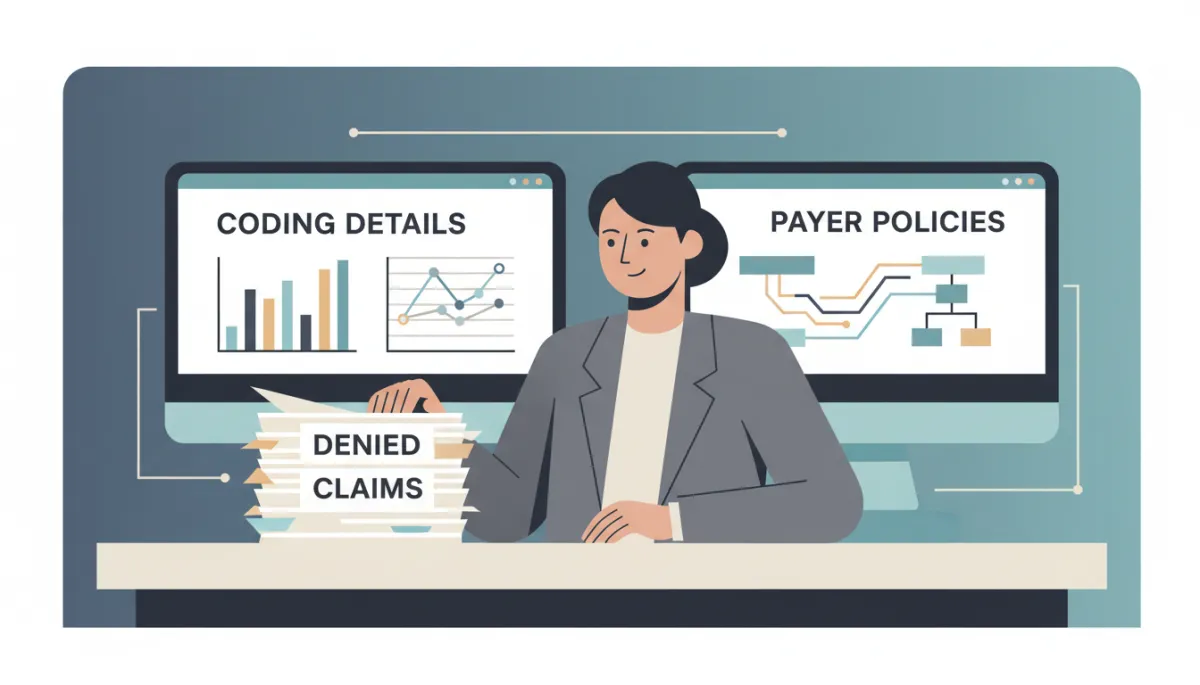
Defense teams must now parse millions of data points to contest denials effectively.
A Massive Market Opportunity for Healthcare Defense Attorneys
When roughly one in five claims is denied across major markets, the volume of potential disputes is staggering. Each percentage point of recoverable claims represents millions of dollars for hospital systems, physician groups, and ancillary providers. Yet, with less than 1% of denials appealed, the vast majority of contested revenue never receives meaningful legal scrutiny.
This gap between denials issued and denials challenged is where the market opens up for healthcare defense attorneys who can:
Offer scalable denial review and appeal services to health systems overwhelmed by volume.
Build data-driven litigation strategies that identify systemic patterns of improper denials across payers and products.
Position themselves as strategic partners to revenue cycle and compliance teams, not just last‑resort litigators.
Why Traditional Approaches Can’t Keep Up
Traditional denial defense is inherently manual and reactive. Paralegals and associates sift through PDFs, EOBs, and medical records; coding experts interpret CPT, ICD‑10, and modifier usage; attorneys crosswalk all of this against plan documents and regulatory standards. This approach breaks down under today’s denial volumes for three reasons:
Sheer scale: When a single health system sees hundreds of thousands—or millions—of denials annually, file‑by‑file review is impossible without leaving money on the table.
Complex coding rules: Denials often hinge on subtle coding edits, bundling rules, and payer‑specific quirks that are difficult to track manually across thousands of claims.
Fragmented data: Medical records, billing data, and payer policies live in separate systems, making it hard to construct a cohesive, evidence‑rich narrative for appeals or litigation.
📌 Key Takeaway: Without automation and analytics, even the best legal teams can only touch a fraction of potentially recoverable denials.
How AI Is Transforming Legal Defense Strategies
By 2026, AI is expected to be deeply embedded in legal practice, from predictive analytics to automated document review (Forbes Tech Council, ABA). In the context of claims denials and medical coding disputes, AI enables defense teams to move from reactive case handling to proactive, portfolio‑level strategy.
Predictive analytics and triage: AI models can scan vast claims datasets to identify patterns of questionable denials, estimate likelihood of success on appeal, and prioritize the highest‑value cases for legal escalation.
Automated document review: Instead of manually combing through records, AI can align clinical documentation with coding, flag mismatches, and surface the exact pages that support coverage and medical necessity arguments.
AI‑assisted legal research: Advanced tools can map denial rationales to applicable statutes, regulations, and prior case outcomes, helping attorneys craft more precise and persuasive arguments at scale.
Why Tools Like CodexLegal.ai Are Now Essential for Coding Dispute Defense
Medical coding disputes sit at the center of the claims denial crisis. With administrative and coding-related reasons driving the majority of denials, defense strategies live or die on the ability to interpret, reconstruct, and defend coding decisions quickly and accurately. This is where specialized AI platforms such as CodexLegal.ai become indispensable.
By combining legal reasoning with deep coding intelligence, an AI tool like CodexLegal.ai can:
Ingest large volumes of denied claims and classify disputes by code, payer, and denial rationale, revealing systemic issues in minutes rather than weeks.
Cross‑reference CPT, ICD‑10, modifiers, and payer policies to identify where denials are inconsistent with published rules or standard industry practice.
Auto‑generate draft appeal letters and legal arguments tailored to each denial type, which attorneys can refine rather than build from scratch.
💡 Pro Tip: Firms that embed AI like CodexLegal.ai into their workflows can handle significantly higher denial volumes without adding headcount—turning the claims denial crisis into a scalable growth engine.
Turning Crisis into Competitive Advantage
The rise in payer denials between 2022 and 2024 is reshaping the economics of healthcare and the practice of healthcare law. For providers, it threatens revenue and access to care. For healthcare defense attorneys, it represents one of the most significant market opportunities in years—provided they can scale beyond traditional, manual methods.
The next generation of leading firms will be those that treat AI not as an optional add‑on, but as a core capability. By leveraging platforms like CodexLegal.ai to power medical coding dispute defense, attorneys can meet surging demand, deliver better outcomes for clients, and bring much‑needed balance back to a payer ecosystem that has tilted too far toward denial.